
Resilient Relationships Through Relational Neuroscience.
How does resilience emerge within relationships?
Relational Resilience
Relational resilience refers to the dynamic capacity of a relationship to maintain, adapt, and restore effective functioning in response to stress, disruption, or changing demands.
Instead of locating resilience solely within individuals, relational resilience conceptualises adaptation as an interpersonal process emerging through the reciprocal regulation, coordination, and repair of interacting partners over time.
Research Programme

Resilient Individuals
How do people regulate and adapt within their relational environments, and what strengthens their capacity for resilience?

Resilient Families
How do close relationships support one another, navigate stress and adapt together over time?

Resilient Teams
How do people coordinate, collaborate and perform effectively in professional and learning environments?
Relational Neuroscience of Resilience Framework
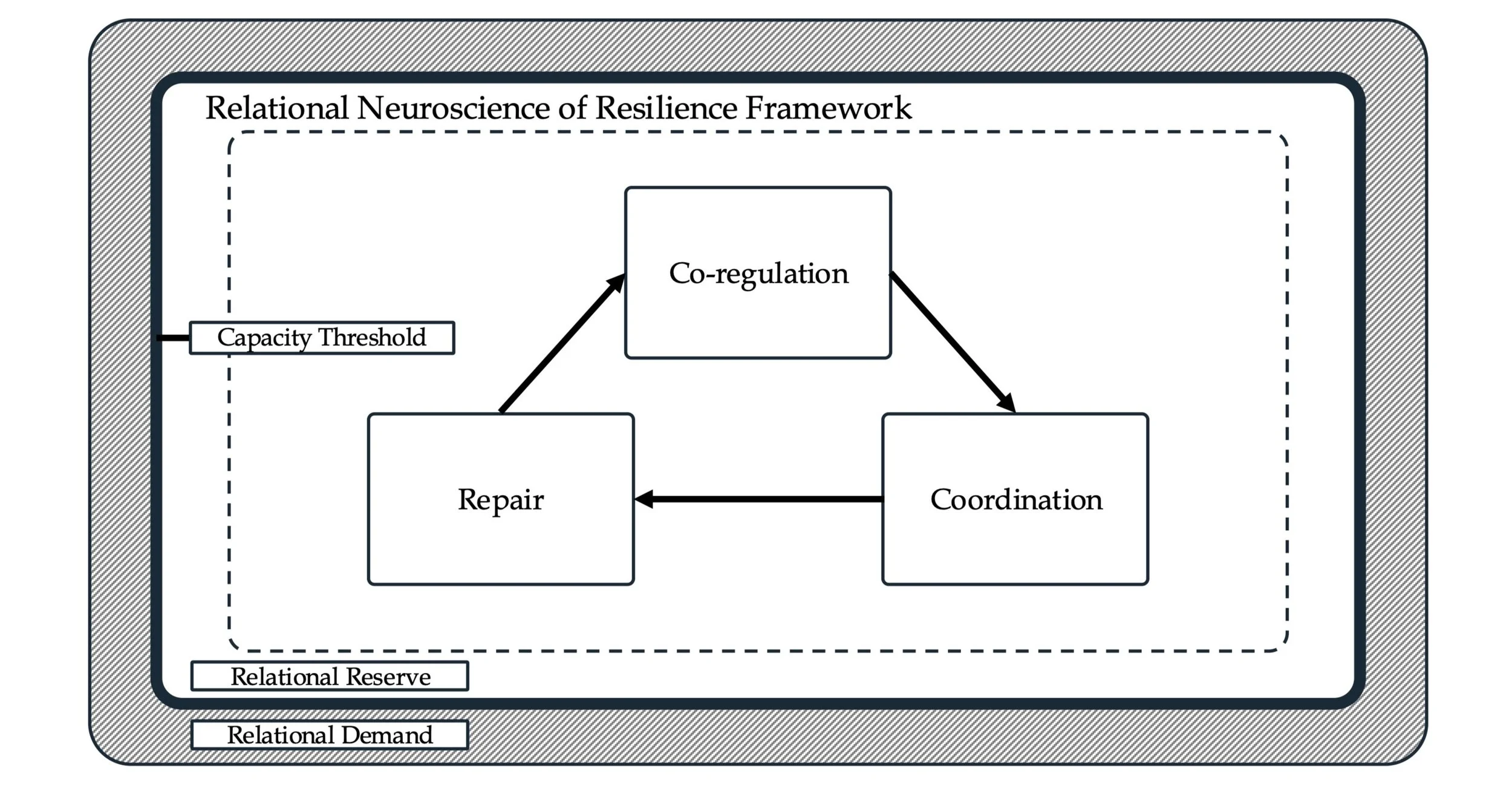
Azhari and Khoo (2026)
The Relational Neuroscience of Resilience Framework (RNRF) explains how resilience emerges within relationships. Drawing on neuroscience research, it brings together three interdependent processes—co-regulation, coordination and repair—within a broader capacity layer comprising relational reserve, relational demand and a capacity threshold. The framework examines how parent–child relationships maintain, lose and restore adaptive functioning under adversity, while offering a starting point for investigating resilience in couples, colleagues and teams.

Meet Atiqah
I am Associate Professor Atiqah Azhari, an award-winning relational neuroscientist at the Singapore University of Social Sciences (SUSS), where I lead The Relational Brain Lab.
I study how relationships shape relational resilience. Through relational neuroscience, I investigate how resilience emerges not only within individuals, but through the relationships and interactions between them
Over the past decade, my research has attracted more than S$5 million in competitive funding and been featured in documentaries, keynote speeches and national media.
My research bridges rigorous academia with real-world impact, integrating neuroscience, behavioural science and technology to understand not only how people adapt, but also how adaptation can be strengthened.
Vision
I believe the future of resilience will not be understood by studying individuals in isolation.
It will be understood by understanding relationships.
My long-term vision is to establish relational neuroscience as a scientific framework for understanding how relationships remain resilient under stress, adapt to challenge and recover from disruption—and to translate this knowledge into evidence-based tools and technologies that strengthen individuals, families, teams and communities at scale.